(from M.Christian's Technorotica)
It might be a tad rough around-the-edges but here's my first - and rather fun, if I do say so myself, reading "Some Assembly Required" from my collection of science fiction, fantasy, and horror stories Love Without Gun Control (out in ebook and a special paper edition) from the great Renaissance E Books/PageTurner Editions:
Showing posts with label love without gun control. Show all posts
Showing posts with label love without gun control. Show all posts
Wednesday, June 10, 2015


Saturday, July 5, 2014
Terrance Aldon Shaw Likes Love Wthout Gun Control
(from M.Christian's Technorotica)
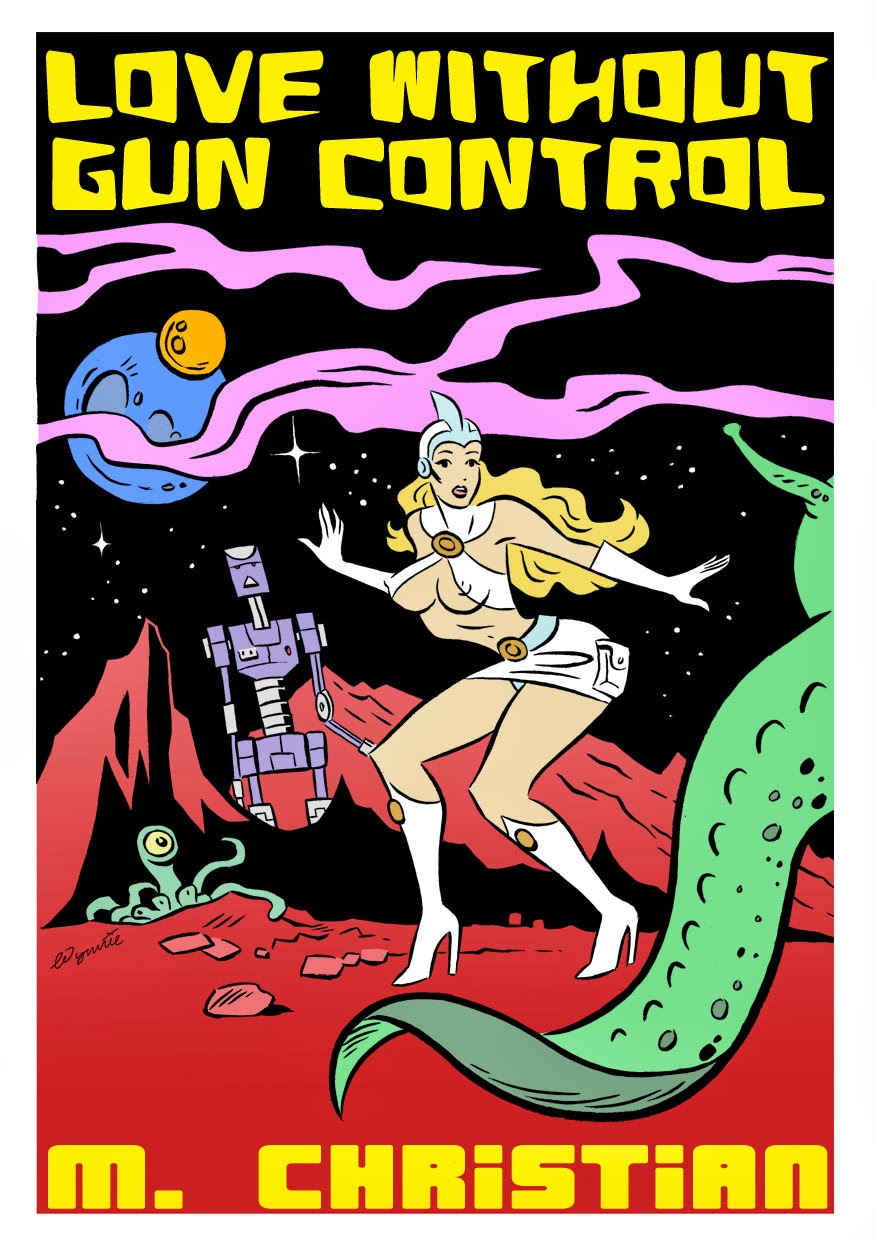
This is just plain wonderful: check out this kick-ass review of my sf/f/h collection, Love Without Gun Control by the very-great Terrance Aldon Shaw on the book's amazon page.
Btw, Love Without Gun Control is currently FREE for a limited time!

Is there any style or genre that M. Christian can’t (or won’t) write in? After reading this very fine short story collection from one of today’s most prolific professionals, I’m leaning heavily towards “no”. The ‘m’ in M. Christian seems to stand for “multi-faceted”, or possibly “mega-multi-tasker”. The guy certainly is versatile, as well as daring, imaginative, often funny, and seldom—if ever—unentertaining, one of those writers who seems to be everywhere at once, though if he has, in fact, cracked the saintly secret of bi-location, he’s not talking.
Readers get a broad sense of Christian’s incredible range in “Love Without Gun Control”, the author’s 2009 self-compiled and –published collection of short fiction, most of which originally appeared in genre anthologies, now-defunct niche-specific literary magazines and long-since cached or dead-linked websites. These fourteen stories run a dizzying—and impressive—gamut of mood and style, each with its own carefully measured ratio of light to shadow, buoyancy to seriousness, horror to humor, and hope to despair.
Christian has clearly learned from, and distilled the essence of the best examples of twentieth-century American fiction, everything from Ray Bradbury and Jack Kerouac to Cormac McCarthy and Stephen King. He does not shy away from his influences, but has wisely allowed them to sing through him as he delves the deep, sometimes silly recesses of the American psyche. The title story is a broad, campy social satire in addition to being a pitch-perfect sendup of old Western movies and TV shows, while “Wanderlust” and “Orphans” pay dark homage to the uniquely American mythos of “the road”—think Steinbeck’s musings on Route 66 in “The Grapes of Wrath”, or the arid, windswept, dread-haunted vistas of Stephen King’s “The Gunslinger” and “The Stand”.
In “Needle Taste”, Christian shows that he is no less adept at horror of the decidedly psychological variety. Techno-thriller melds seamlessly with High Fantasy in “The Rich Man’s Ghost”; political satire meets The Zombie Apocalypse in “Buried with the Dead”, while knotty existential drama and the classic Post-Apocalyptic narrative come together in “1,000”, and “Nothing So Dangerous”, a story of love and betrayal in a time of revolution. Perhaps my favorite stories in this collection are the beautiful, elegiac, Bradbury-esque “Some Assembly Required,” a narrative at once clever and poignant, and the brilliantly breezy “Constantine in Love”:
“It was called The Love Shack, and it sold all kinds of obvious things: candy, flowers, poetry books, jewelry, balloons, perfume, lingerie, and many other sweet, frilly, and heart-shaped items. It stood alone, bracketed by two vacant lots. Its busiest days were just before Valentine’s and Christmas. It was described by many newspapers and tourist guides as “. . . the place to go when love is on your mind.”
The night was dark, the place was closed. The streets were quiet.
Then the Love Shack exploded—with a fantastic shower of fragmented chotchkes, and flaming brick-a-brack, it went from a shop dedicated to amore to a skyrocket of saccharine merchandise. Flaming unmentionables drifted down to land in smoking heaps in the middle of the street, lava flows of melted and burning chocolate crawled out for the front door, teddy bears burned like napalm victims, and cubic zirconia mixed with cheap window glass—both showering down the empty, smoldering hole that used to be the store . . .”
I do have a few complaints as well. In several of these stories, I found myself wishing for a stronger editorial hand. The text needs a good, personally-detached copyedit. Several otherwise excellent stories (“Hush, Hush”; “1,000”; “Friday”) are simply too long to effectively maintain the emotional impact for which the author aims. I found them overly repetitive and rather dull, with the narrative lines collapsing into nebulous incoherency. After all, the “short” in short fiction should be a clue to the essence of the form; all unnecessary baggage and ballast summarily jettisoned to achieve an economy of language, and, with it, maximum expression. Christian is an established and well-respected editor in his own right, but no matter how skillful or perceptive an author may be as an editor of other people’s work, when it comes to self-editing, even the best and brightest have their blind spots.
Still, there’s far more to like and admire in this collection than to kvetch about or pan. Readers will be well-rewarded for what is, in the end, a ridiculously modest price of admission.
This is just plain wonderful: check out this kick-ass review of my sf/f/h collection, Love Without Gun Control by the very-great Terrance Aldon Shaw on the book's amazon page.
Btw, Love Without Gun Control is currently FREE for a limited time!
Is there any style or genre that M. Christian can’t (or won’t) write in? After reading this very fine short story collection from one of today’s most prolific professionals, I’m leaning heavily towards “no”. The ‘m’ in M. Christian seems to stand for “multi-faceted”, or possibly “mega-multi-tasker”. The guy certainly is versatile, as well as daring, imaginative, often funny, and seldom—if ever—unentertaining, one of those writers who seems to be everywhere at once, though if he has, in fact, cracked the saintly secret of bi-location, he’s not talking.
Readers get a broad sense of Christian’s incredible range in “Love Without Gun Control”, the author’s 2009 self-compiled and –published collection of short fiction, most of which originally appeared in genre anthologies, now-defunct niche-specific literary magazines and long-since cached or dead-linked websites. These fourteen stories run a dizzying—and impressive—gamut of mood and style, each with its own carefully measured ratio of light to shadow, buoyancy to seriousness, horror to humor, and hope to despair.
Christian has clearly learned from, and distilled the essence of the best examples of twentieth-century American fiction, everything from Ray Bradbury and Jack Kerouac to Cormac McCarthy and Stephen King. He does not shy away from his influences, but has wisely allowed them to sing through him as he delves the deep, sometimes silly recesses of the American psyche. The title story is a broad, campy social satire in addition to being a pitch-perfect sendup of old Western movies and TV shows, while “Wanderlust” and “Orphans” pay dark homage to the uniquely American mythos of “the road”—think Steinbeck’s musings on Route 66 in “The Grapes of Wrath”, or the arid, windswept, dread-haunted vistas of Stephen King’s “The Gunslinger” and “The Stand”.
In “Needle Taste”, Christian shows that he is no less adept at horror of the decidedly psychological variety. Techno-thriller melds seamlessly with High Fantasy in “The Rich Man’s Ghost”; political satire meets The Zombie Apocalypse in “Buried with the Dead”, while knotty existential drama and the classic Post-Apocalyptic narrative come together in “1,000”, and “Nothing So Dangerous”, a story of love and betrayal in a time of revolution. Perhaps my favorite stories in this collection are the beautiful, elegiac, Bradbury-esque “Some Assembly Required,” a narrative at once clever and poignant, and the brilliantly breezy “Constantine in Love”:
“It was called The Love Shack, and it sold all kinds of obvious things: candy, flowers, poetry books, jewelry, balloons, perfume, lingerie, and many other sweet, frilly, and heart-shaped items. It stood alone, bracketed by two vacant lots. Its busiest days were just before Valentine’s and Christmas. It was described by many newspapers and tourist guides as “. . . the place to go when love is on your mind.”
The night was dark, the place was closed. The streets were quiet.
Then the Love Shack exploded—with a fantastic shower of fragmented chotchkes, and flaming brick-a-brack, it went from a shop dedicated to amore to a skyrocket of saccharine merchandise. Flaming unmentionables drifted down to land in smoking heaps in the middle of the street, lava flows of melted and burning chocolate crawled out for the front door, teddy bears burned like napalm victims, and cubic zirconia mixed with cheap window glass—both showering down the empty, smoldering hole that used to be the store . . .”
I do have a few complaints as well. In several of these stories, I found myself wishing for a stronger editorial hand. The text needs a good, personally-detached copyedit. Several otherwise excellent stories (“Hush, Hush”; “1,000”; “Friday”) are simply too long to effectively maintain the emotional impact for which the author aims. I found them overly repetitive and rather dull, with the narrative lines collapsing into nebulous incoherency. After all, the “short” in short fiction should be a clue to the essence of the form; all unnecessary baggage and ballast summarily jettisoned to achieve an economy of language, and, with it, maximum expression. Christian is an established and well-respected editor in his own right, but no matter how skillful or perceptive an author may be as an editor of other people’s work, when it comes to self-editing, even the best and brightest have their blind spots.
Still, there’s far more to like and admire in this collection than to kvetch about or pan. Readers will be well-rewarded for what is, in the end, a ridiculously modest price of admission.
Wednesday, March 19, 2014
Love Without Gun Control Celebration
As part of my wonderful Love Without Gun Control sale, here's a fan-favorite piece from the book. Enjoy!
She hadn't thought about Mark in years – then, suddenly, she did. It wasn't something obvious, like seeing his face on someone else's who also had pale blond hair, like burnished steel, or eyes like amber marbles, but something swift and intangible, like a floating piece of consciousness you remember as not being fact, reality, but part of a dream half-forgotten.
Lisa had been standing in the warm sunshine down on Solano Avenue, walking back with her sister from seeing a movie – something with explosions and lots of male sweat, details already mostly forgotten. They'd parked far away, and chatted emptily as they marched back to Lisa's battered little sports car.
He'd had a tension about him sometimes, an almost tangible armor that would slip over him. The first time it had happened they'd fought later in the day, Lisa convinced on some level that she'd been the cause. It had happened, so quickly and without apparent cause and had lingered for hours, and he hadn't spoken a word about it. When the same had happened to Lisa, in other relationships, it usually meant anger at her, a stewing resentment just needing an impetus to release. Better, she'd learned, to get it out when she wanted to – beat the fight to the punch.
Hot, hard sunlight in her eyes and she replied mechanically to Shirley's polite sisterly banter. Why now – why think of that and Mark... now? The laughter of children in front of a nearby toy store, an old woman glacially making her way down the sidewalk in a mechanical walker, a burnished Latino man clipping branches from a tree in front of a doctor's office.
“Some people just shouldn't have children,” Shirley said, slipping into the passenger seat as Lisa absently hunted for the ignition. Lisa looked up, hunting for the source, and saw the three with the kids: two glowing parents, and a friend. The parents were young and sleek with their own kind of baby fat – the softness that Lisa had seen around her other friends that had the innocence and responsibility of children thrust onto them. “Luckily,” Shirley said, her eyes obscured by sunglasses, “other people can.”
Their friend wasn't sleek, wasn't soft. His hair was slightly greasy, his jeans rough and faded to threads in some places – and even though he was smiling with his friends and the children he had to accompany, his tension was obvious.
Lisa knew, that fragment finding it's place in her mind: the why of thinking of Mark. Yeah, some people shouldn't have children, but other people – good, kind people – were terrified of them.
It was night by the time she got back to her apartment, parking as usual in the darkness of the alley behind her building. After an afternoon with Shirley, Mark had faded into a cool melancholy – a lazy sadness about many things, old and nearly forgotten boyfriends only some of it.
At first she thought it was an insect, and fear/disgust/revulsion tingled up and down her spine. Then she thought it might be a toy – children being up way to late. Then she picked it up. Looking at it under the washed-out distant lights from the street beyond, she again thought specifically of one old boyfriend and brought it inside.
His breath had been hot – she remembered when it seemed about to scald her neck, how she'd felt she'd had to move – just a little – from under him, feeling it almost ready to burn her skin. He always seemed to have a bruise or two, looking like a swatch of grease on his angular body, from where he'd hurt himself at work.
The apartment seemed empty, cold – so she turned on the coffee machine and absently flicked on the set to keep her company. Her answering machine was beeping one, one, one in dark red – so she didn't play it, knowing it to be Shirley saying she'd be late for the movie.
The little machine wasn't a toy – it had a kind of patched-together, crude look to it. Putting it down on her kitchen counter it immediately started a hesitant exploration of its new environment. Smiling despite herself, she lunged to catch it as it neared an edge – only to have it pull away at the last minute. It had a couple of small motors, maybe scavenged from a toy after all. It had wire feelers, and a mysterious cluster of dark glass panels along its back. Its body seemed to be a piece of an old circuit board, the green material almost black in some places from being outside for a long time. It seemed to have eyes, as well, two discs facing forward. Yes, eyes, as she watched it hunted along her counter-top for light. It had a battery, a black box along its back, but must have fed, recharged, on what it could see – eating light through the flat glass panels on its back.
Also on its back was a cigar tube. Picking it up, Lisa shook it, hearing something inside. Carefully, she unscrewed it – and a tightly rolled sheet of paper came out.
Mark was very much in her mind. The gruff rumble of his voice, the deep avalanche of his laughter. For someone who saw tools as an extension of his self, he liked surprisingly subtle and sophisticated things. When he was crouched over some new machine, or under some behemoth of gears and engines, Bach chimed from his speakers. When he stopped to eat it was usually Sushi or Thai, and while he enjoyed watching things explode and men sweat on the screen he also had a complete Win Wenders collection and worshipped Jacques Tati.
The instructions on the paper were simple, straightforward. Even for someone like Lisa for whom Mark's terminology had been like listening to an ancient Asiatic language, she could understand it. It was also obviously a copy of a copy of a copy of a copy – the pattern of the diagrams in some places blurred by replication.
She stayed up for a long time, staring at the instructions and thinking about Mark, while the little machine patiently explored its new world – charging its battery from her kitchen lights.
The parts were surprisingly easy to find. Two trips to two different electronic stores. Cheap too – or would have been had she had some of the tools it required at hand.
Practicing with the soldering iron, she thought a lot about Mark. She built him, assembled him from memory as he sent curls of acid smoke up towards the ceiling: tall, thin – rough but not course, with a kind of mechanic's masculinity. Machines had been a special language for him, the key to a secret world of cause and effect. She remembered how his amber eyes glowed when he talked about some new project, some new device or construction – explaining to her innocence the philosophy of its gears, the beauty of its mechanisms.
She didn't have any photographs. No letters. They hadn't been together long – two and a half, maybe three years. She couldn't even remember why they'd broken up... exactly. She knew a lot of it was because of his passion, and her revelation that, at best, she'd only be the second most important thing in his life.
She burned herself, gesturing clumsily with the iron like it was a pencil or pen and not a very hot tool. The pain was like a flash in her eyes and she dropped it – luckily on the table and not on the carpet. After sucking on the inside of her finger when the iron had touched and almost crying, she breathed deep a few times and went back to trying to get enough with the unfamiliar tool.
That fight was very present in her mind. They had gone to a picnic with her sister, who'd been baby-sitting her friend's six-year-old. Mark hadn't made any noises when she'd told him about it, but that tension descended on him hard and fast whenever he was near the kid. Sally was a sweet girl, shy but very smart and with laughter that sounded like chiming bells. Still, Mark had been terrified.
Lisa hadn't known that – and so the fight: beat him to it, get it out in the open. For a long time he just stood there and let her run all over the place trying to figure out why he was so angry. Finally, he said something – and then something else, and then she started to understand. That night they'd made love – and it had been different. Passionate, yes, but also caring – an act to seal up a wound that had been opened.
When Shirley came over the next day she saw the mess of electronic parts scattered on her kitchen counter. “Toaster explode?” she joked, picking up something only three days before Lisa wouldn't have recognized.
“Just a hobby,” Lisa said, defensively, feeling as if Shirley had been picking through her bedside table, commenting on her method of birth control.
“Looks like something Mark would have put together – spit and bailing wire, couple of batteries and... viola, art. Too bad everyone else just saw it as some bailing wire and lots of spit.”
Mark hadn't called it art. He might have treated it that way, but he never called it that. “Yeah,” Lisa said, grabbing her purse, “but that's what he liked to do.” Then she said, not at all hungry, just to get her sister away, “let's get a bite, I'm starved.”
“You think about him... Mark – a lot.”
“Sometimes,” she said, gently moving her sister towards the front door.
“You weren't together all that long, and it weren't even with him when he, you know, passed away.” At the door, she paused. “Cancer, wasn’t it?”
“Yes, cancer–”
“He didn't leave much behind did he? I think you were the only person who knew him well – and that's not saying a lot.”
“No,” she agreed, locking her front door, “not a lot at all.” ****
She decided to build two of them. That way she could have some practice and not put too much pressure on herself to get the one-and- only done perfectly. She burned herself, twice more – but then felt like she was really getting a handle on the iron. Her nose tickled for a long time from the resin-reek of the melting solder, but then she started to enjoy it – it was like an incense from some distant, mechanical land. Something burned in Mark's church.
It wasn't hate that had tensed him that day in the park around dear little – it was responsibility. “I was scared. Damn, I hate that – that feeling. Like walking on glass. They're so fragile, you know. I know what that was like, how one wrong thing... well, it might not mean anything to me, but to them it could be how they see the world after. That freaks me out. I'm not ready to do it right, I guess – I'm too selfish. When I want to do, I want to do it right, to be there all the time for them – to really be there for them, to help them. Now, though, the responsibility scares me.”
“You just have to let go,” she'd told him, holding him close and feeling his breathing, hot breathing on the side of her neck. “Other people have the same fears, but they manage okay. You just have to learn to let go. It's how we go on – it's how you leave a part of yourself behind. You're just scared because you only want to leave the best of you behind.”
He'd nodded, his heavy body moving slightly, too, as his head did. “I know. I just keep thinking that... maybe I'm not good enough.”
The first one Lisa built had faltered, as if stricken with a kind of electronic/mechanical palsy. She went back to the instruction sheet and spent a few minutes following it's strange course. There, finally she saw it, a stray wire, a hesitant short. After a quick, skillful jab with the soldering iron it seemed to work fine.
At dawn, which seemed appropriate, she took copies she'd made of the instructions, put them in the cigar tubes she'd bought, attached them to their backs, and let them go. The original moved across the alley, vanishing quickly off into the distance. Her first born started off to the right, slowly making its way among the trash cans and garage doors; the whine of its little electric motors went on for a long time, until fading into the general background of the city.
The second born went to the left, darting across the dark asphalt – but then stopped just about halfway. It stayed there for a minute, spinning slowly as it sought nutritious sunlight. Finally it stopped its dance and made its way slowly down the other side of the alley, until vanishing among some parked cars.
The tears were a surprise, there before she was even aware she was crying. She watched her descendants until she felt they were able to make it on their own, then she wished them well, gave them her love, and went back inside.
Some Assembly Required
She hadn't thought about Mark in years – then, suddenly, she did. It wasn't something obvious, like seeing his face on someone else's who also had pale blond hair, like burnished steel, or eyes like amber marbles, but something swift and intangible, like a floating piece of consciousness you remember as not being fact, reality, but part of a dream half-forgotten.
Lisa had been standing in the warm sunshine down on Solano Avenue, walking back with her sister from seeing a movie – something with explosions and lots of male sweat, details already mostly forgotten. They'd parked far away, and chatted emptily as they marched back to Lisa's battered little sports car.
He'd had a tension about him sometimes, an almost tangible armor that would slip over him. The first time it had happened they'd fought later in the day, Lisa convinced on some level that she'd been the cause. It had happened, so quickly and without apparent cause and had lingered for hours, and he hadn't spoken a word about it. When the same had happened to Lisa, in other relationships, it usually meant anger at her, a stewing resentment just needing an impetus to release. Better, she'd learned, to get it out when she wanted to – beat the fight to the punch.
Hot, hard sunlight in her eyes and she replied mechanically to Shirley's polite sisterly banter. Why now – why think of that and Mark... now? The laughter of children in front of a nearby toy store, an old woman glacially making her way down the sidewalk in a mechanical walker, a burnished Latino man clipping branches from a tree in front of a doctor's office.
“Some people just shouldn't have children,” Shirley said, slipping into the passenger seat as Lisa absently hunted for the ignition. Lisa looked up, hunting for the source, and saw the three with the kids: two glowing parents, and a friend. The parents were young and sleek with their own kind of baby fat – the softness that Lisa had seen around her other friends that had the innocence and responsibility of children thrust onto them. “Luckily,” Shirley said, her eyes obscured by sunglasses, “other people can.”
Their friend wasn't sleek, wasn't soft. His hair was slightly greasy, his jeans rough and faded to threads in some places – and even though he was smiling with his friends and the children he had to accompany, his tension was obvious.
Lisa knew, that fragment finding it's place in her mind: the why of thinking of Mark. Yeah, some people shouldn't have children, but other people – good, kind people – were terrified of them.
****
It was night by the time she got back to her apartment, parking as usual in the darkness of the alley behind her building. After an afternoon with Shirley, Mark had faded into a cool melancholy – a lazy sadness about many things, old and nearly forgotten boyfriends only some of it.
At first she thought it was an insect, and fear/disgust/revulsion tingled up and down her spine. Then she thought it might be a toy – children being up way to late. Then she picked it up. Looking at it under the washed-out distant lights from the street beyond, she again thought specifically of one old boyfriend and brought it inside.
His breath had been hot – she remembered when it seemed about to scald her neck, how she'd felt she'd had to move – just a little – from under him, feeling it almost ready to burn her skin. He always seemed to have a bruise or two, looking like a swatch of grease on his angular body, from where he'd hurt himself at work.
The apartment seemed empty, cold – so she turned on the coffee machine and absently flicked on the set to keep her company. Her answering machine was beeping one, one, one in dark red – so she didn't play it, knowing it to be Shirley saying she'd be late for the movie.
The little machine wasn't a toy – it had a kind of patched-together, crude look to it. Putting it down on her kitchen counter it immediately started a hesitant exploration of its new environment. Smiling despite herself, she lunged to catch it as it neared an edge – only to have it pull away at the last minute. It had a couple of small motors, maybe scavenged from a toy after all. It had wire feelers, and a mysterious cluster of dark glass panels along its back. Its body seemed to be a piece of an old circuit board, the green material almost black in some places from being outside for a long time. It seemed to have eyes, as well, two discs facing forward. Yes, eyes, as she watched it hunted along her counter-top for light. It had a battery, a black box along its back, but must have fed, recharged, on what it could see – eating light through the flat glass panels on its back.
Also on its back was a cigar tube. Picking it up, Lisa shook it, hearing something inside. Carefully, she unscrewed it – and a tightly rolled sheet of paper came out.
****
Mark was very much in her mind. The gruff rumble of his voice, the deep avalanche of his laughter. For someone who saw tools as an extension of his self, he liked surprisingly subtle and sophisticated things. When he was crouched over some new machine, or under some behemoth of gears and engines, Bach chimed from his speakers. When he stopped to eat it was usually Sushi or Thai, and while he enjoyed watching things explode and men sweat on the screen he also had a complete Win Wenders collection and worshipped Jacques Tati.
The instructions on the paper were simple, straightforward. Even for someone like Lisa for whom Mark's terminology had been like listening to an ancient Asiatic language, she could understand it. It was also obviously a copy of a copy of a copy of a copy – the pattern of the diagrams in some places blurred by replication.
She stayed up for a long time, staring at the instructions and thinking about Mark, while the little machine patiently explored its new world – charging its battery from her kitchen lights.
****
The parts were surprisingly easy to find. Two trips to two different electronic stores. Cheap too – or would have been had she had some of the tools it required at hand.
Practicing with the soldering iron, she thought a lot about Mark. She built him, assembled him from memory as he sent curls of acid smoke up towards the ceiling: tall, thin – rough but not course, with a kind of mechanic's masculinity. Machines had been a special language for him, the key to a secret world of cause and effect. She remembered how his amber eyes glowed when he talked about some new project, some new device or construction – explaining to her innocence the philosophy of its gears, the beauty of its mechanisms.
She didn't have any photographs. No letters. They hadn't been together long – two and a half, maybe three years. She couldn't even remember why they'd broken up... exactly. She knew a lot of it was because of his passion, and her revelation that, at best, she'd only be the second most important thing in his life.
She burned herself, gesturing clumsily with the iron like it was a pencil or pen and not a very hot tool. The pain was like a flash in her eyes and she dropped it – luckily on the table and not on the carpet. After sucking on the inside of her finger when the iron had touched and almost crying, she breathed deep a few times and went back to trying to get enough with the unfamiliar tool.
That fight was very present in her mind. They had gone to a picnic with her sister, who'd been baby-sitting her friend's six-year-old. Mark hadn't made any noises when she'd told him about it, but that tension descended on him hard and fast whenever he was near the kid. Sally was a sweet girl, shy but very smart and with laughter that sounded like chiming bells. Still, Mark had been terrified.
Lisa hadn't known that – and so the fight: beat him to it, get it out in the open. For a long time he just stood there and let her run all over the place trying to figure out why he was so angry. Finally, he said something – and then something else, and then she started to understand. That night they'd made love – and it had been different. Passionate, yes, but also caring – an act to seal up a wound that had been opened.
When Shirley came over the next day she saw the mess of electronic parts scattered on her kitchen counter. “Toaster explode?” she joked, picking up something only three days before Lisa wouldn't have recognized.
“Just a hobby,” Lisa said, defensively, feeling as if Shirley had been picking through her bedside table, commenting on her method of birth control.
“Looks like something Mark would have put together – spit and bailing wire, couple of batteries and... viola, art. Too bad everyone else just saw it as some bailing wire and lots of spit.”
Mark hadn't called it art. He might have treated it that way, but he never called it that. “Yeah,” Lisa said, grabbing her purse, “but that's what he liked to do.” Then she said, not at all hungry, just to get her sister away, “let's get a bite, I'm starved.”
“You think about him... Mark – a lot.”
“Sometimes,” she said, gently moving her sister towards the front door.
“You weren't together all that long, and it weren't even with him when he, you know, passed away.” At the door, she paused. “Cancer, wasn’t it?”
“Yes, cancer–”
“He didn't leave much behind did he? I think you were the only person who knew him well – and that's not saying a lot.”
“No,” she agreed, locking her front door, “not a lot at all.” ****
She decided to build two of them. That way she could have some practice and not put too much pressure on herself to get the one-and- only done perfectly. She burned herself, twice more – but then felt like she was really getting a handle on the iron. Her nose tickled for a long time from the resin-reek of the melting solder, but then she started to enjoy it – it was like an incense from some distant, mechanical land. Something burned in Mark's church.
It wasn't hate that had tensed him that day in the park around dear little – it was responsibility. “I was scared. Damn, I hate that – that feeling. Like walking on glass. They're so fragile, you know. I know what that was like, how one wrong thing... well, it might not mean anything to me, but to them it could be how they see the world after. That freaks me out. I'm not ready to do it right, I guess – I'm too selfish. When I want to do, I want to do it right, to be there all the time for them – to really be there for them, to help them. Now, though, the responsibility scares me.”
“You just have to let go,” she'd told him, holding him close and feeling his breathing, hot breathing on the side of her neck. “Other people have the same fears, but they manage okay. You just have to learn to let go. It's how we go on – it's how you leave a part of yourself behind. You're just scared because you only want to leave the best of you behind.”
He'd nodded, his heavy body moving slightly, too, as his head did. “I know. I just keep thinking that... maybe I'm not good enough.”
The first one Lisa built had faltered, as if stricken with a kind of electronic/mechanical palsy. She went back to the instruction sheet and spent a few minutes following it's strange course. There, finally she saw it, a stray wire, a hesitant short. After a quick, skillful jab with the soldering iron it seemed to work fine.
At dawn, which seemed appropriate, she took copies she'd made of the instructions, put them in the cigar tubes she'd bought, attached them to their backs, and let them go. The original moved across the alley, vanishing quickly off into the distance. Her first born started off to the right, slowly making its way among the trash cans and garage doors; the whine of its little electric motors went on for a long time, until fading into the general background of the city.
The second born went to the left, darting across the dark asphalt – but then stopped just about halfway. It stayed there for a minute, spinning slowly as it sought nutritious sunlight. Finally it stopped its dance and made its way slowly down the other side of the alley, until vanishing among some parked cars.
The tears were a surprise, there before she was even aware she was crying. She watched her descendants until she felt they were able to make it on their own, then she wished them well, gave them her love, and went back inside.
Monday, January 6, 2014
SPECIAL DISCOUNTS! Love Without Gun Control And Welcome To Weirdsville!


Great news for the new year: my science fiction/fantasy/horror collection, Love Without Gun Control is now for sale (all over the place) for only .99 - and my very fun weird history and facts book, Welcome To Weirdsville, is only $2.99!

And that's not all! Lots of my queer erotica and fiction has also been discounted for 2014! More on this later but check out that BodyWork: Male-Male Erotica is FREE!!
Wednesday, January 2, 2013
Read (And Listen To) "Some Assembly Required" From The Bachelor Machine
As you (ahem) may have heard, I recorded a reading of my SF story, "Some Assembly Required" from Love Without Gun Control
Just for fun, here's the story itself (pasted below). Enjoy!
Some Assembly Required
She hadn't thought about Mark in years – then, suddenly, she did. It wasn't something obvious, like seeing his face on someone else's who also had pale blond hair, like burnished steel, or eyes like amber marbles, but something swift and intangible, like a floating piece of consciousness you remember as not being fact, reality, but part of a dream half-forgotten.
Lisa had been standing in the warm sunshine down on Solano Avenue, walking back with her sister from seeing a movie – something with explosions and lots of male sweat, details already mostly forgotten. They'd parked far away, and chatted emptily as they marched back to Lisa's battered little sports car.
He'd had a tension about him sometimes, an almost tangible armor that would slip over him. The first time it had happened they'd fought later in the day, Lisa convinced on some level that she'd been the cause. It had happened, so quickly and without apparent cause and had lingered for hours, and he hadn't spoken a word about it. When the same had happened to Lisa, in other relationships, it usually meant anger at her, a stewing resentment just needing an impetus to release. Better, she'd learned, to get it out when she wanted to – beat the fight to the punch.
Hot, hard sunlight in her eyes and she replied mechanically to Shirley's polite sisterly banter. Why now – why think of that and Mark... now? The laughter of children in front of a nearby toy store, an old woman glacially making her way down the sidewalk in a mechanical walker, a burnished Latino man clipping branches from a tree in front of a doctor's office.
“Some people just shouldn't have children,” Shirley said, slipping into the passenger seat as Lisa absently hunted for the ignition. Lisa looked up, hunting for the source, and saw the three with the kids: two glowing parents, and a friend. The parents were young and sleek with their own kind of baby fat – the softness that Lisa had seen around her other friends that had the innocence and responsibility of children thrust onto them. “Luckily,” Shirley said, her eyes obscured by sunglasses, “other people can.”
Their friend wasn't sleek, wasn't soft. His hair was slightly greasy, his jeans rough and faded to threads in some places – and even though he was smiling with his friends and the children he had to accompany, his tension was obvious.
Lisa knew, that fragment finding it's place in her mind: the why of thinking of Mark. Yeah, some people shouldn't have children, but other people – good, kind people – were terrified of them.
****
It was night by the time she got back to her apartment, parking as usual in the darkness of the alley behind her building. After an afternoon with Shirley, Mark had faded into a cool melancholy – a lazy sadness about many things, old and nearly forgotten boyfriends only some of it.
At first she thought it was an insect, and fear/disgust/revulsion tingled up and down her spine. Then she thought it might be a toy – children being up way to late. Then she picked it up. Looking at it under the washed-out distant lights from the street beyond, she again thought specifically of one old boyfriend and brought it inside.
His breath had been hot – she remembered when it seemed about to scald her neck, how she'd felt she'd had to move – just a little – from under him, feeling it almost ready to burn her skin. He always seemed to have a bruise or two, looking like a swatch of grease on his angular body, from where he'd hurt himself at work.
The apartment seemed empty, cold – so she turned on the coffee machine and absently flicked on the set to keep her company. Her answering machine was beeping one, one, one in dark red – so she didn't play it, knowing it to be Shirley saying she'd be late for the movie.
The little machine wasn't a toy – it had a kind of patched-together, crude look to it. Putting it down on her kitchen counter it immediately started a hesitant exploration of its new environment. Smiling despite herself, she lunged to catch it as it neared an edge – only to have it pull away at the last minute. It had a couple of small motors, maybe scavenged from a toy after all. It had wire feelers, and a mysterious cluster of dark glass panels along its back. Its body seemed to be a piece of an old circuit board, the green material almost black in some places from being outside for a long time. It seemed to have eyes, as well, two discs facing forward. Yes, eyes, as she watched it hunted along her counter-top for light. It had a battery, a black box along its back, but must have fed, recharged, on what it could see – eating light through the flat glass panels on its back.
Also on its back was a cigar tube. Picking it up, Lisa shook it, hearing something inside. Carefully, she unscrewed it – and a tightly rolled sheet of paper came out.
****
Mark was very much in her mind. The gruff rumble of his voice, the deep avalanche of his laughter. For someone who saw tools as an extension of his self, he liked surprisingly subtle and sophisticated things. When he was crouched over some new machine, or under some behemoth of gears and engines, Bach chimed from his speakers. When he stopped to eat it was usually Sushi or Thai, and while he enjoyed watching things explode and men sweat on the screen he also had a complete Win Wenders collection and worshipped Jacques Tati.
The instructions on the paper were simple, straightforward. Even for someone like Lisa for whom Mark's terminology had been like listening to an ancient Asiatic language, she could understand it. It was also obviously a copy of a copy of a copy of a copy – the pattern of the diagrams in some places blurred by replication.
She stayed up for a long time, staring at the instructions and thinking about Mark, while the little machine patiently explored its new world – charging its battery from her kitchen lights.
****
The parts were surprisingly easy to find. Two trips to two different electronic stores. Cheap too – or would have been had she had some of the tools it required at hand.
Practicing with the soldering iron, she thought a lot about Mark. She built him, assembled him from memory as he sent curls of acid smoke up towards the ceiling: tall, thin – rough but not course, with a kind of mechanic's masculinity. Machines had been a special language for him, the key to a secret world of cause and effect. She remembered how his amber eyes glowed when he talked about some new project, some new device or construction – explaining to her innocence the philosophy of its gears, the beauty of its mechanisms.
She didn't have any photographs. No letters. They hadn't been together long – two and a half, maybe three years. She couldn't even remember why they'd broken up... exactly. She knew a lot of it was because of his passion, and her revelation that, at best, she'd only be the second most important thing in his life.
She burned herself, gesturing clumsily with the iron like it was a pencil or pen and not a very hot tool. The pain was like a flash in her eyes and she dropped it – luckily on the table and not on the carpet. After sucking on the inside of her finger when the iron had touched and almost crying, she breathed deep a few times and went back to trying to get enough with the unfamiliar tool.
That fight was very present in her mind. They had gone to a picnic with her sister, who'd been baby-sitting her friend's six-year-old. Mark hadn't made any noises when she'd told him about it, but that tension descended on him hard and fast whenever he was near the kid. Sally was a sweet girl, shy but very smart and with laughter that sounded like chiming bells. Still, Mark had been terrified.
Lisa hadn't known that – and so the fight: beat him to it, get it out in the open. For a long time he just stood there and let her run all over the place trying to figure out why he was so angry. Finally, he said something – and then something else, and then she started to understand. That night they'd made love – and it had been different. Passionate, yes, but also caring – an act to seal up a wound that had been opened.
When Shirley came over the next day she saw the mess of electronic parts scattered on her kitchen counter. “Toaster explode?” she joked, picking up something only three days before Lisa wouldn't have recognized.
“Just a hobby,” Lisa said, defensively, feeling as if Shirley had been picking through her bedside table, commenting on her method of birth control.
“Looks like something Mark would have put together – spit and bailing wire, couple of batteries and... viola, art. Too bad everyone else just saw it as some bailing wire and lots of spit.”
Mark hadn't called it art. He might have treated it that way, but he never called it that. “Yeah,” Lisa said, grabbing her purse, “but that's what he liked to do.” Then she said, not at all hungry, just to get her sister away, “let's get a bite, I'm starved.”
“You think about him... Mark – a lot.”
“Sometimes,” she said, gently moving her sister towards the front door.
“You weren't together all that long, and it weren't even with him when he, you know, passed away.” At the door, she paused. “Cancer, wasn’t it?”
“Yes, cancer–”
“He didn't leave much behind did he? I think you were the only person who knew him well – and that's not saying a lot.”
“No,” she agreed, locking her front door, “not a lot at all.” ****
She decided to build two of them. That way she could have some practice and not put too much pressure on herself to get the one-and- only done perfectly. She burned herself, twice more – but then felt like she was really getting a handle on the iron. Her nose tickled for a long time from the resin-reek of the melting solder, but then she started to enjoy it – it was like an incense from some distant, mechanical land. Something burned in Mark's church.
It wasn't hate that had tensed him that day in the park around dear little – it was responsibility. “I was scared. Damn, I hate that – that feeling. Like walking on glass. They're so fragile, you know. I know what that was like, how one wrong thing... well, it might not mean anything to me, but to them it could be how they see the world after. That freaks me out. I'm not ready to do it right, I guess – I'm too selfish. When I want to do, I want to do it right, to be there all the time for them – to really be there for them, to help them. Now, though, the responsibility scares me.”
“You just have to let go,” she'd told him, holding him close and feeling his breathing, hot breathing on the side of her neck. “Other people have the same fears, but they manage okay. You just have to learn to let go. It's how we go on – it's how you leave a part of yourself behind. You're just scared because you only want to leave the best of you behind.”
He'd nodded, his heavy body moving slightly, too, as his head did. “I know. I just keep thinking that... maybe I'm not good enough.”
The first one Lisa built had faltered, as if stricken with a kind of electronic/mechanical palsy. She went back to the instruction sheet and spent a few minutes following it's strange course. There, finally she saw it, a stray wire, a hesitant short. After a quick, skillful jab with the soldering iron it seemed to work fine.
At dawn, which seemed appropriate, she took copies she'd made of the instructions, put them in the cigar tubes she'd bought, attached them to their backs, and let them go. The original moved across the alley, vanishing quickly off into the distance. Her first born started off to the right, slowly making its way among the trash cans and garage doors; the whine of its little electric motors went on for a long time, until fading into the general background of the city.
The second born went to the left, darting across the dark asphalt – but then stopped just about halfway. It stayed there for a minute, spinning slowly as it sought nutritious sunlight. Finally it stopped its dance and made its way slowly down the other side of the alley, until vanishing among some parked cars.
The tears were a surprise, there before she was even aware she was crying. She watched her descendants until she felt they were able to make it on their own, then she wished them well, gave them her love, and went back inside.
Friday, December 21, 2012
M.Christian Reads His Science Fiction Story "Some Assembly Required" from LOVE WITHOUT GUN CONTROL
(from M.Christian's Technorotica)
It might be a tad rough around-the-edges but here's my first - and rather fun, if I do say so myself, reading "Some Assembly Required" from my collection of science fiction, fantasy, and horror stories Love Without Gun Control (out in ebook and a special paper edition) from the great Renaissance E Books/PageTurner Editions:
Subscribe to:
Posts (Atom)