Tuesday, February 13, 2007

Do not adjust your monitor's aspect ratio: the Sakuradani Light Railway


Once again I'm clueless to any more info on this delightful "Garden Railway" because of the Net's inabilty to translate Kanji properly without it sounding like bad stereo instructions. Frankly it really does not matter, all I care about is that it merely exists.

... but the downside is that my "commute" from my front porch to my side garden has now become rather dull, no clicking of the rails, no teahouse-slash-railway halts, and no flower ventors at the terminus, but I must be brave and carry on still.

"'Gadzooks,' quoth I, 'but here's a saucy bawd!'"

"I, Libertine was one of the all-time great literary hoaxes. It began as a practical joke by late-night radio raconteur Jean Shepherd. Shepherd was highly annoyed at the way that the bestseller lists were being compiled in the mid-1950s. These lists were not determined only on sales figures but also on requests for new books at bookstores.

"Shepherd urged his listeners to enter bookstores and ask for a book that did not exist. He fabricated the author (Frederick R. Ewing) of this imaginary novel, concocted a title (I, Libertine), and outlined a basic plot for his listeners to use on skeptical or confused bookstore clerks. Shepherd eventually proved his point that the process of choosing bestsellers was flawed.

"Bookstores became interested in carrying Ewing's novel, which reportedly had been banned in Boston. When publisher Ian Ballantine, novelist Theodore Sturgeon and Shepherd met for lunch, Ballantine hired Sturgeon to write a novel based on Shepherd's outline. Betty Ballantine completed the final chapter after an exhausted Sturgeon fell asleep on the Ballantines' couch, having attempted to meet the deadline in one marathon typing session. On September 13, 1956, Ballantine Books published I, Libertine simultaneously in hardcover and paperback editions with Shepherd seen as Ewing in the back cover photograph ...."

On a personal note, my sweet lady will forever be in my heart for a birthday gift of an original copy, which now sits prominently on my desk: an inspiration to mischievous, and frustrated, writers everywhere.

Paper Dreams


Sadly, I do not know the name of this brillaint artist, but I have seen his work often in the Japanese motorcyle magazine "Goggle" (I love the names of the pan-asain magazines) Not true Oragami mind you, but delicate sculpting and forming of craft paper-if you look at the backround of the robot rider you can get a look at his working tools.

Monday, February 12, 2007

polarize the headlights and set the engine for silent running


Long ago in TV land there was this very successful up and coming producer named William Dozier. In 1965 Dozier called Dean Jeffries to build the Batmobile for the upcoming TV show. Jeffries agreed and set to work on a 59 Cadillac. Two weeks later Dozier called and said they moved up the timetable and they needed the car in 3 weeks and Jeffries knowing that he would not be able to do a job he was proud of, declined the task of making the Batmobile. Desperate Dozier contacted George Barris and in roughly 3 weeks the Batmobile was born out of the 1955 Lincoln Futura show car.

It was 1966 when "Batman" the ever-popular TV series aired. Trying to duplicate that success, producers at 20th Century Fox brought forth The Green Hornet starring Bruce Lee as Kato in 1966. Many a young child got their first exposure to martial arts with the introduction of this show.

Dozier was unhappy with the job Barris did so, Dean Jeffries, was contacted by the studio and asked to create a car to rival the Batmobile but be a little more realistic. Jeffries chose a 1966 Chrysler Crown Imperial for the task. Very possibly Chrysler's first prominent TV/Movie car! He created only two cars for the show, one is currently in the hands of a California collector and the other has recently been discovered and is on the east coast. (Barris created 4 replicas for touring at car shows but without Jeffries or the studio's approval). Thanks to the Imperial Car Club for the info.

This is the sad and odd story of Dan "JR" Goodman, who bought one of the "original" Black Beauties and had it restored by the builder himself, Dean Jeffries. The story takes another odd route when my brother and I had the - and I use the word very loosely - "opportunity" to buy one of the Barris clones. Sadly parents with no true insight of a what a proper first car is for their motorhead sons prompty killed the plan, there where many, many tense years afterwards I can tell you, particuarly when we had another opportunity to buy one of the Barris knockoff Easy Rider "Captain America" show bikes ... for all of $800.00 - again vetoed.

There once was a girl named Rodan ...

... who lived off the coast of Japan.

A common definition of genius is the elegant combination of otherwise contradictory elements. S.A. completely qualifies because when I sent him the link to a group of RC tank wargamers -

- he responded by suggesting the too-suitable attire:

The Obakemono project


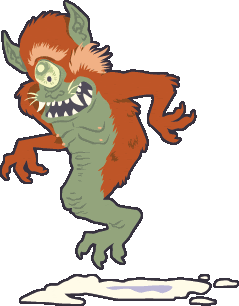
Ippon-datara

"This shy monster is rarely encountered by humans, and all that is usually seen of it is a single line of huge footprints about a foot across, winding through the snowy mountains of Wakayama prefecture.

"In Japanese, O is a prefix denoting respect, and bakemono literally means a changed thing - something perverted and altered and moved beyond its natural state - a monster.

"To most Western eyes, traditional Japan is a serene veneer of stoic samurai, porcelain-skinned geisha, Mount Fuji and cherry blossoms. It seems like the last place you'd look for things bizarre, grotesque, and morbid. And yet the Japanese archipelago is home to as rich a tradition of goblins, ghouls, and monsters as you'll find anywhere on Earth. Imported from the mainland along with Buddhism or Chinese culture, or springing from fertile local imaginations and ancient animistic traditions, this impressive array of animated objects, transformed animals, ogres, demons, and human freaks is known collectively known as yōkai (yoh-kye), or bakemono (bah-keh-mo-no). They feature in countless folktales, prints, and paintings, often rendered with as much humor as horror, a troupe of beasts as charming as they are terrifying.

"Sekien Toriyama was the first to catalogue Japan's vast bestiary, and in 1776 published a hefty illustrated tome called the "Hyakki Yakō", or "Hundred Demon Night Parade." Many since him have attempted to follow in his footsteps, the most notable among these being cartoonist Shigeru Mizuki, who has written and lavishly illustrated numerous books on the subject, all while keeping the yōkai alive in the public's imagination through his strange, enchanting comic stories.

"In English-speaking nations, Japan's popular culture has of late enjoyed immense popularity in the form of animation, comic books, and video games, and Godzilla and his fellow giant rubber-suit monsters have always had a cult following. But the kaijū's older cousins, the yōkai, remain largely a footnote and a curiosity in the West. Occasionally they sneak over in the form of a low-budget monster movie, or show up altered, toned-down, or romanticized into unrecognizability in an imported cartoon popular with teens. Yet much of the fertile, monstrous imagination contained in old Japanese folklore and art has never been collected, translated, and presented to the English-speaking world.

"With more than two hundred creatures slated to be illustrated and described, the Obakemono Project hopes to fill this void."

UrVille


Gilles Trehin is an autistic 28-year-old. Since the age of 12, he has been designing an imaginary city called Urville, named after the “Dumont d’Urville,” a French scientific base in Antarctica. He has created detailed historical, geographical, cultural, and economic descriptions of the city, as well as an absolutely extraordinary set of drawings. His Guidebook to Urville will be published later this year.

..When I tell people I have an apartment in a city that exists only in the mind of a brilliant austistic boy I get very strange looks, but when I tell them I live in a city designed by simple-minded, life hating, ignoble minds they just smile and complain about the lack of offramps and too-few starbucks.

The Beautiful world of Kino's Journey


In Kino's Journey, the protagonist, Kino, accompanied by a talking motorrad, a Brough Superior motorcycle named Hermes, travels through a mystical world of many different countries and forests, each unique in its customs and people. Kino only spends 3 days and 2 nights in every town, without exception, on the principle that three days is enough time to learn almost everything important about a place, while leaving time to explore new lands. Kino does say in The Land of Visible Pain this principle is probably a lie, specifically noting "if I stay any longer, I'm afraid I will settle down."

...A phrase repeated in the anime and novels is "The world is not beautiful, therefore it is."

take me there right now: Brooklyn Superhero Supply


HISTORY
826NYC is modeled after 826 Valencia, a nonprofit writing lab and tutoring center located in San Francisco's Mission District. Founded by writer Dave Eggers and a group of energetic and passionate volunteers, 826 Valencia opened its doors in April 2002.

826NYC's writing center opened its doors in September 2004. Since then our programs have offered over one thousand students opportunities to improve their writing at our center. Our staff has grown to include 4 employees and over 250 volunteers.

826 NATIONAL is essentially an umbrella organization that works toward duplicating the successful 826 Valencia program in youth writing centers across the country. In fact, we are already hard at work. 826NYC (in Park Slope, Brooklyn) opened in September 2004. 826LA (in Los Angeles) opened in March 2005. Currently, centers are in the process of opening in Seattle, Ann Arbor and Chicago. Each 826-style center will provide the same amount and caliber of volunteer-based, free services for students that 826 Valencia in San Francisco has successfully developed. We couldn't be more excited.

coffee house cowboys: The Cult of the Cafe Racers


A Café racer, originally pronounced "caff" (as in Kaff) racer, is a type of motorcycle as well as a type of motorcyclist. Both meanings have their roots in the 1960s British counterculture group the Rockers or the Ton Up Club, although they were also common in Italy, amongst Italian motorcycle manufacturers and other European countries.
Rockers were a young and rebellious Rock and Roll counterculture that wanted a fast, personalised and distinctive bike to travel between transport cafés along the newly built arterial motorways in and around British towns and cities. The goal of many was to be able to reach 100 miles per hour (called simply "the ton") along such a route where the rider would leave from a cafe, race to a predetermined point and back to the cafe before a single song could play on the jukebox, this was called record-racing.

The term Cafe racer is still used to describe motorcycles of a certain style and some motorcyclists still use this term in self-description. A cafe racer is a motorcycle that has been modified for speed and good handling rather than comfort; single racing seats, low handle bars such as ace bars or even one-sided "clip-ons" mounted directly onto the front forks for control and aerodynamics, half or full race fairings, large racing petrol tanks often left unpainted, swept back exhausts and rearset footpegs in order to give better clearance whilst cornering at speed. These motorcycles were lean, light and handled road surfaces well. The most defining machine of the Rocker heyday was the homemade Norton Featherbed framed and Triumph Bonneville engined machine called " The Triton ". It used the most common and fastest racing engine combined with the best handling frame of its day.

Worthy of mentioning here is that an entire new sub-culture has evolved since the heyday of the Rockers. The 'Cafe Racers', a term that existed in the 1950s and 1960s to refer to bike riders of the race track, but is used now to describe motorcycle riders who choose classic/vintage British, Italian or Japanese motorbikes from the 50's-to late 1970s as their bike of choice(like the Honda Supersport in the picture above) , over Harleys or new Japanese bikes. These Cafe Racers do not follow the fashion/music subculture of the Rockers, old or new, but dress in a more modern and comfortable appearance with only a hint of likeness to the Rockers style. Common Levi jeans, generic motorcycle jackets, boots and/or shoes with modern helmets being the norm, instead of the very specific brand names, styles and look established by the Rockers. These Cafe Racers have taken elements of the American Greaser, British Rocker and modern motorcycle rider look to create a style all their own.

Because the affects of drinking alcohol are detrimental and thus inarguably recklessly dangerous for operating any motor vehicle it is obvious why Cafe Racers choose to stop for drinks of coffee rather than alcohol. The operating of motorcycles after consuming alcohol is somewhat acceptable to the image of riding choppers or cruisers further making them the antithesis of Cafe Racing. A lighthearted term has arisen for motorcyclists who dare to ride between places where they can consume alcohol, such as a tavern, called "TtT Racing" which is a play of words on TT Racing and an anagram of riding from: "Tavern-to-Tavern".