Wednesday, October 15, 2008

One of Our Favorite Heroes: Big Guy


Wiki:
The Big Guy and Rusty the Boy Robot is a comic book by Frank Miller and Geof Darrow and an eponymous animated television series.

"Big Guy and Rusty, the Boy Robot" appeared under Dark Horse Comics' now defunct Legend imprint as a large format comic book published as a two-part mini-series in 1996, featuring story by Frank Miller and art by Geof Darrow. In the comic, the story revolves around an attack on Tokyo by a giant reptilian creature that is generated in an experiment gone wrong, and the failure of the newly-commissioned Rusty the Boy Robot to stop the threat. Subsequently, Japan requested help from the U.S. Armed Forces, whose ultimate defense, the robot Big Guy, launches from his air carrier base and uses his awesome arsenal and good old-fashioned American know-how to save the day.

The comic book features intricate artwork by Geof Darrow, and story by Frank Miller, of Batman: The Dark Knight Returns and Sin City fame. The two had previously collaborated on the "Hard Boiled", another story combining Miller's short spoken and violent storytelling with Darrow's graphomaniacally meticulous art. The Big Guy's first story appeared without Rusty in two issues of Mike Allred's "Madman" comic, after appearing in various comic book pin-up and poster pages.

The animated series, produced by Columbia TriStar Television and Dark Horse Entertainment, aired from 1999 to 2001, and in many aspects is a more mature and established series. Whereas the comic book seems like only an introduction to the robots, the animated series is full-fledged with a strong back story which links the episodes together. The plot and setting of the series is different from the comic book as the whole story is based around New Tronic City, a fictional American city clearly modeled after New York City. Rusty is the most advanced robot with human emotional grid and nucleoprotonic powers that is going to replace the Big Guy, the Earth's last line of defense against all threats alien, domestic, or against the American way. However, Rusty is too inexperienced to stand on his own, so the Big Guy is re-commissioned to teach Rusty the way of trade. Rusty idolizes the Big Guy, regarding him as the best robot ever. Big Guy is actually piloted by Lieutenant Dwayne Hunter, who poses as his chief mechanic. Big Guy's secret is known only to a few, and many situations involve Lt. Hunter's clever and impromptu excuses to hide the fact from Rusty for two reasons: that the truth could overload Rusty's emotional grid; and Rusty has trouble keeping secrets.

The theme song is notoriously difficult to understand, with many words garbled by the intro video which includes the sounds of weapons firing. It consists of a montage with a ballad of the back history of Big Guy and the creation of Rusty, sung in a deep voice:

"Watch the skies, coming at you,
A hero of metal hue,
He locks horns with disaster,
For the red and white and blue,
Then was born a boyrobot,
Miracle of science,
Ready to battle large monsters,
Supercharged and quick on the draw,
Pretty darn good, but he needs help,
The Big Guy, he's a big deal,
Heart of gold, and fists of steel,
Clobbering evil entities, with Rusty at his heel,
Now that they're a mighty team,
The boy robot lives his dream,
To be a legend in history,
The Big Guy and Rusty!"

Tuesday, October 14, 2008

- and the kitchen sink


Wiki:
Hurra Torpedo is a band from Norway who play songs using kitchen appliances. They were formed in the early nineties, are part of the artistic collective Duplex Records, and all members of the band also play in a variety of other bands in Norway.

During recent years Hurra Torpedo have had annual split- and reunion tours. The band struck international fame when a television performance of the 1983 Bonnie Tyler power ballad "Total Eclipse of the Heart", using kitchen appliances for percussion, spread as an internet meme. The clip, from a Norwegian comedy-variety show called Lille lørdag ("Little Saturday") (aired on Wednesdays - "the Little Saturday" in the Norwegian week), was filmed in 1995. In early 2005 the clip was uploaded to the internet.

In the clip, the band, dressed in ill-fitting jogging suits, play on a stage surrounded by various kitchen appliances. Frontman Hegerberg plays guitar and sings in a slightly off-key monotone and with a strong Norwegian accent, Schau "drums" by hitting a stove with a stick and slamming the door of a freezer, while Guttormsgaard adds backing vocals, and at the climax smashes the top of an electrical stove with a large piece of metal more or less on the beat of the song.

Sunday, October 12, 2008

Everybody Loves Hypnotoad

Wiki:

Futurama is an Emmy Award-winning animated American sitcom created by Matt Groening, and developed by Groening and David X. Cohen for the Fox network. The series follows the adventures of a former New York pizza delivery boy, Philip J. Fry, after he is cryogenically frozen, seconds after the start of the twenty-first century, and wakes up in the year 3000.

The name "Futurama" comes from a pavilion at the 1939 New York World's Fair. Designed by Norman Bel Geddes, the Futurama pavilion depicted how he imagined the world to look in 1959.

The Hypnotoad is a large toad with oscillating, multicolored eyes which emit a loud, ominous buzzing noise. It has the power to hypnotize almost any living thing at will, even mass numbers of creatures. It has its own television show, Everybody Loves Hypnotoad, in which it hypnotizes the audience. The film Futurama: Bender's Big Score includes a full 22-minute episode on the DVD. The episode mainly features the Hypnotoad staring into the camera, occasionally intercut with a laugh track or shots of the exterior of various locations to indicate a scene change. The finale of the show consists of a voiceover telling the audience that they will wake up remembering nothing and feeling refreshed, and the credits are all attributed to Hypnotoad. The loud noise made by the toad is a stock sound dubbed "Angry Machine," which was originally used by the editors to remind themselves to replace it with a more appropriate sound effect.

Thursday, October 9, 2008

Movies You Haven't Seen But Should: Jacques Tati's Trafic


Trafic from the IMDB:
At Altra Motors, Mr. Hulot designs an ingenious camper car with lots of clever features. A lorry hauls the prototype to an important auto show in Amsterdam, with Mr. Hulot alongside in his car and a spoiled, trendy PR exec, the young Maria, in her sports car packed with designer clothes and her fluffy dog. The lorry has every imaginable problem, delaying its arrival. A flat tire, no gas, an accident, a run-in with police, a stop at a garage, and numerous traffic jams showcase vignettes of people and their cars. Through interactions with these down-to-earth folks, Maria gradually loses her imperious conceit, becoming much more relaxed and fetching.


Wednesday, October 8, 2008

The Goon Show: "A nice man wrote the time down for me this morning."


Wiki:

The Goon Show was a British radio comedy programme, originally produced and broadcast by the BBC Home Service from 1951 to 1960, with occasional repeats on the BBC Light Programme. The first series, broadcast between May and September 1951, was titled Crazy People; all subsequent series had the overall title The Goon Show.

The show's chief creator and main writer was Spike Milligan. The scripts mixed ludicrous plots with surreal humour, puns, catchphrases and an array of bizarre sound effects. Some of the later episodes feature electronic effects devised by the fledgling BBC Radiophonic Workshop, many of which were reused by other shows for decades afterward. Many elements of the show satirised contemporary life in Britain, parodying aspects of show business, commerce, industry, art, politics, diplomacy, the police, the military, education, class structure, literature and film.

NBC began broadcasting the programme on its radio network from the mid-1950s. The programme exercised a considerable influence on the subsequent development of British and American comedy and popular culture. It was cited as a major influence by the Monty Python team and the American comedy team The Firesign Theater.

The series was devised and written by Spike Milligan with the regular collaboration of other writers including (singly) Larry Stephens, Eric Sykes, Maurice Wiltshire and John Antrobus, under the watchful eye of Jimmy Grafton (KOGVOS - Keeper of the Goons and Voice of Sanity). However, on four occasions during the 8th series, Milligan was unable to come up with scripts, so Stephens wrote "The Stolen Postman", and Stephens and Wiltshire "The Thing On The Mountain", "The Moriarty Murder Mystery" and "The White Neddie Trade", in very convincing Milligan-esque style. In the 9th series, when a similar situation occurred, Stephens and Wiltshire also wrote "The Seagoon Memoirs" (Stephens had contributed a solo script during the 4th series). Many senior BBC staff were bemused by the show's surreal humour and it has been reported that senior programme executives erroneously referred to it as The Go On Show or even The Coon Show.

Milligan and Harry Secombe became friends while serving in the Royal Artillery during World War II; they met up with Peter Sellers and Michael Bentine back in England after the war and got together in Grafton's pub performing and experimenting with tape recorders. Famously, Milligan first encountered Secombe after Gunner Milligan's artillery unit accidentally allowed a large howitzer to roll off a cliff - under which Secombe was sitting in a small wireless truck: "Suddenly there was a terrible noise as some monstrous object fell from the sky quite close to us. There was considerable confusion, and in the middle of it all the flap of the truck was pushed open and a young, helmeted idiot asked 'Anybody see a gun?' It was Milligan..."

This show was enormously popular in Britain in its heyday; tickets for the recording sessions at the BBC's Aeolian Hall studio in London were constantly over-subscribed and the various character voices and catchphrases from the show quickly became part of the vernacular. The series has remained consistently popular ever since – it is still being broadcast once a week by the ABC in Australia, as well as on BBC 7; and it has exerted a singular influence over succeeding generations of comedians and writers, most notably the creators of Monty Python's Flying Circus and The Beatles' movies.


Tuesday, October 7, 2008

Eat The Rich

"I'd like to have you for dinner, Mr. Rockefeller ...."

Wiki:
Michael Clark Rockefeller (born 1938 - presumed dead November 17, 1961), was the youngest son of New York Governor (later Vice President) Nelson Aldrich Rockefeller and Mary Todhunter Rockefeller and a fourth generation member of the Rockefeller family. He disappeared during an expedition in the Asmat region of southwestern New Guinea.

On November 17, 1961, Rockefeller and Dutch anthropologist René Wassing were in a 40-foot dugout canoe about three miles from shore when their double pontoon boat was swamped and overturned. Their two local guides swam for help, but it was slow in coming. After drifting for some time, Rockefeller said to Wassing "I think I can make it" and swam for shore. Wassing was rescued the next day, while Rockefeller was never seen again, despite an intensive and lengthy search effort. At the time, Rockefeller's disappearance was a major world news item. His body was never found. He was declared legally dead in 1964.

Most believe that Rockefeller either drowned or was attacked by a shark or crocodile. Because headhunting and cannibalism were still present in some areas of Asmat in 1961, some have speculated that Rockefeller was killed and eaten by local people.

In 1969, the journalist Milt Machlin traveled to New Guinea to investigate Rockefeller's disappearance. He dismissed reports of Rockefeller's living as a captive or as a Kurtz-like figure in the jungle, but concluded that there was circumstantial evidence to support the idea that he was killed. Several leaders of Otsjanep village, where Rockefeller likely would have arrived had he made it to shore, were killed by a Dutch patrol in 1958, and thus would have some rationale for revenge against someone from the "white tribe." Neither cannibalism nor headhunting in Asmat were indiscriminate, but rather were part of a tit-for-tat revenge cycle, and so it is possible that Rockefeller found himself the inadvertent victim of such a cycle started by the Dutch patrol.

A book called Rocky Goes West by author Paul Toohey claims that, in 1979, Rockefeller's mother hired a private investigator to go to New Guinea and try to resolve the mystery of his disappearance. The reliability of the story has been questioned, but Toohey claims that the private investigator swapped a boat engine for the skulls of the three men that a tribe claimed were the only white men they had ever killed. The investigator returned to New York and handed these skulls to the family, convinced that one of them was the skull of Rockefeller. If this event did actually occur, the family has never commented on it. There was, however, a report on the History Channel that Rockefeller's mother did pay a $250,000 reward to the investigator which was offered for final proof whether or not Michael Rockefeller was alive or dead.

"Grill 5 degrees before reaching the desired doneness ...."

Monday, October 6, 2008

Dark Roasted Weirdsville


If you love classic pulp artists - and I certainly do - check out my new article on Dark Roasted Blend:

Grand Old Times … In The Future
The polished humanism of Star Trek; the grungy mythology of Star Wars; the uncomplicated flesh versus machine of Battlestar Galactica, the Terminator flicks, and the Matrix movies –- the future is all around us. Bitter, sweet, dark, light: You just have to pick your flavor for what you want tomorrow to be.

But step back just a few decades and recall how looking at tomorrow was solely for newsstands and tawdry bookstores, which presented a loudly lurid universe of glistening glass tubes, gleaming chrome starships, and frantically faced diabolical scientists of the very-mad and very-bad variety. Amazing Stories, Weird Tales, Wonder Stories, Astounding Science Fiction, Planet Stories, and the rest of their pulpy kin were secret sins, magazines smuggled home to be read under the covers by the dying batteries of a Boy Scout flashlight.

At the time, the artists working for the pulps weren’t considered anything but cheap creatives providing cheap entertainment for cheap minds. But now we know what they were: visions of wonder, amazing vistas of the imagination, daring dreams of possibility, magnificent views of What Could Be -- but most of all we look back at what they did and recognize it for being truly magnificent art.

Unfortunately there isn’t enough time or space to touch on all of the artists who worked for the pulps that were printed between (roughly) 1920 (something) and 1950 (something), but here’s a quick guide to some of my own personal favorites, the artists who created a world of tomorrow when today was the only thing people could see.

You have no choice but to be amazed by Frank R. Paul’s Amazing Stories covers. While the world was coughing and spitting behind the wooden wheels of Model T Fords or barely getting off the ground in biplanes, Paul created wonderful scientific dreams for a wonderful array of magazines. His visions might have been built from the stuff of those early days –- tubes, wires, electrodes, sprawling cities –- but Paul had a bravery of scope: steamships flew through the sky, tidal waves cracked skyscrapers in half, dozens of alien vistas sparked the imagination, and scientists peered into the vastness of space with telescopes the size of mountains. But whatever the size of his scope, Paul also filled his images with incredible detail, giving each one a reality that made his work like a functional blueprint for the future and not just an enticement to drop a nickel for an afternoon’s amusement.


Although he’s also legendary for his covers, praise for Virgil Finlay has mostly been –- rightfully -- given out for his black and white interior work. Sure he also had scope, drama, crazy dreams, and pulp outrageousness but to see a Finlay illustration is to be hushed into silence by its beauty, subtlety, and sensuality. It's easy to picture his images from Weird Tales hanging in the great galleries of the world. The fact that much of his early work was for neglected and belittled pulps like Weird Tales is nothing short of infuriating.


Hannes Bok has to be on this stage of artistic magnificence as well. Like Finlay, his style is refined and elegant, so much more than the pulps he worked for. But he also brought a playful madness to his illustrations: a twisted kind of beauty to his figures and environments. Looking at a Bok cover, you didn’t know whether what you were looking at was a dream or a nightmare, but you always felt that it was rich, glowing with passion, perfectly composed, and absolutely brilliant.


Another inspired illustrator, one that jumped from the pulps to pretty much every kind of illustration, is was the legendary Wally Wood. It would take a book, hardly a short article, to just begin to touch on Wally’s scope: Weird Science comics, romance comics, Tales From The Crypt, trading cards, Mad Magazine and even some hilarious smut, including the legendary Disney orgy poster. Wood wasn’t just prolific or insanely flexible: whatever he did, and he did a lot, he brought with him a precise touch, a winking sense of whimsy, but also a carefully balanced sense of drama. You always knew you were looking at something Wood had done, and you were always amazed by it.


When you mention Frank Kelly Freas many people immediately think of his iconic cover for Astounding Science Fiction, the one that Freas also did for Queen’s album. But when I think of Freas I prefer to think of the delightfully winking cover he did, also for Astounding, for Frederick Brown’s Martians, Go Home. That, for me, is Freas: there is perfect technique, marvelous color, ideal drama and composition, but there’s also his marvelous sense of whimsy, a kind of bright and sparkling joy you can see in whatever Freas did, and what makes his work always compelling.


There are too many fantastic artists who worked in the pulps to touch on them all on this little space, but I can’t go without at least mentioning Chesley Bonestell. Even though you can’t really call Bonestell a ‘pulp’ artist, he deserves a bit of space for what he did for … well, ‘space.’ Considered by many to be the father of modern space illustration, Bonestell was the man who realized the scientific projections of Willey Ley and Wernher von Braun and the motion picture dreams of George Pal. His paintings –- elegant, quiet, and magnificent -- were, for many people, not what the future could be, but what the future would be: a world of rockets and starships and men looking back at the earth from the distant moon.


That’s all for now but if there’s a lesson to be learned it’s that even though we might live in a world right next door to the future, there’s still a lot the past can teach us. Like, that real treasures and fantastic art can be found in places we might stupidly dismiss as simple, cheap, or pulpish.

Sunday, October 5, 2008

The Atuk Curse

"I don''t think it will make a good movie ...."

Wiki:

Atuk (Grandfather) is the name of a screenplay adaptation based on the 1963 novel The Incomparable Atuk by Mordecai Richler. It is basically a Fish out of water comedy of a proud, mighty Eskimo hunter trying to adapt to life in the big city.

There are subtle satirical elements on racism and modern culture and society, which figure much more prominently in the novel than in the script. Another difference between the script and the novel is, in the screenplay Atuk is a native of Alaska who ends up in New York City whereas in the novel he is a Canadian Eskimo poet from Baffin Island who gets transplanted to Toronto. Peter Gzowski's afterword adds some historical context, and elaborates on the satirized real-life counterparts of several of the novel's minor characters, including Pierre Berton.

Atuk is most infamous, however, for supposedly being cursed and, at least partly responsible for the deaths of several major comedic actors in the 1980s and 1990s. The Atuk Curse has become one of the best known urban legends of Hollywood. Its first victim, supposedly, was John Belushi, who had read the script and was reportedly enthusiastic about taking on the role of Atuk. Shortly afterwards, he was found dead of a drug overdose in 1982. The curse's next alleged victim was Sam Kinison, who took on the role in the late 80's and filmed at least one scene for the film before he grew dissatisfied with the script and quit. He ultimately died in an automobile accident in 1992. The curse would strike again in 1994 when John Candy, who had been approached for the role of Atuk, was reading the script when he suddenly died of a heart attack, on March 4 (the day before the 12th anniversary of Belushi's death). Some believe the curse struck twice that year, since in November Michael O'Donoghue died of a cerebral hemorrhage. O'Donoghue was a writer and comedian who was also a friend of Belushi and Kinison and, the story goes, had read the script (in some versions even worked on it) before recommending it to them. The final victim of the Atuk Curse, to date, is said to be Chris Farley, who idolized John Belushi. Like his idol, he was up for the role of Atuk, and was about to accept when, also like his idol, he died of a drug overdose in December 1997. Although according to some versions the curse would strike once more only six months later in May 1998 when Farley's friend and former Saturday Night Live cast-mate, Phil Hartman was murdered by his wife. Farley is said to have shown the Atuk script to Hartman, before his death, and was encouraging him to take a co-starring role.

Atuk has not and, due to its infamy (along with the fact so many involved with it seem to keep dying), in all likelihood never will be made into a film. A copy of the script was purportedly put up for auction on eBay in recent years. The curse has been a featured topic on several TV shows and documentaries. Ironically the author of the novel on which it is based, Richler, and writer of the afterword Gzowski both died peacefully in 2001 and 2002 respectively, after enjoying long lives and successful careers.

The movie was also referenced in the commentary track for 2004's Anchorman: The Legend of Ron Burgundy, in which Adam McKay repeatedly pitches a screenplay called "Eskimo in New York" to Will Ferrell. Will remarks several times that he doesn't think it will make a good movie, and refuses to be a part of it.

Friday, October 3, 2008

Mind the Gap: The Legend of the Silverpilen

Wiki:

Silverpilen ("The Silver Arrow") is a ghost subway train that haunts the Stockholm Metro, according to an urban legend circulating in the Swedish capital Stockholm. The train is usually referred to as being composed of silver model C5 cars. Only one such train, composed of eight cars, was built; it was manufactured in the mid-1960s as a test and taken out of service years ago and replaced by more modern cars.

The silver train was rarely seen, which may have given rise to stories of a mystical white, shimmering ghost train, especially if people saw it at night. The stories that circulated most widely in the 1980s have been retold by the noted Swedish folklorist Bengt af Klintberg, and later featured in an installment of a television series dedicated to allegedly real ghost stories and haunted houses, Det spökar, aired on December 10, 1997.

There are different versions of this urban legend. Some say that the ghost train has only been seen in abandoned tunnels by subway workers. Others say that anyone can see it passing the stations at high speed after midnight. Some even claim that Silverpilen sometimes stops to pick up passengers, who then disappear forever or later "get off" weeks, months or even years after they embarked. The inside of the train is described as being empty, or as containing one or several ghost passengers.

Some stories connect the ghost train with the abandoned Kymlinge metro station on Line 11, the blue line. Kymlinge also has a reputation of being a ghost station, with people saying that "Bara de döda stiger av i Kymlinge" -- "Only the dead get off at Kymlinge." The ghost stories of Silverpilen can be compared to those of the ghost ship The Flying Dutchman.

Wednesday, October 1, 2008

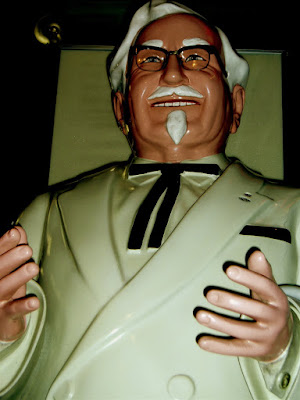
Curse of the Colonel: Beware His Cluck Of Doom

Beware His Cluck Of Doom

Wiki:

Curse of the Colonel refers to an urban legend regarding a reputed curse placed on the Japanese Kansai-based Hanshin Tigers baseball team by deceased KFC founder and mascot Colonel Harland Sanders. The curse was said to be placed on the team because of the Colonel's anger over treatment of one of his store-front statues.

In 1985, much to Japanese people's surprise, the Hanshin Tigers faced the Seibu Lions and took their first and only victory in the Japan Series, largely due to star slugger Randy Bass, a gaijin (foreigner) player for the team.

The rabid fan base went wild, and a riotous celebration gathered at Ebisubashi Bridge in Dotonbori, Osaka. There, an assemblage of supporters yelled the players names, and with every name a fan resembling a member of the victorious team leapt from the bridge into the waiting canal. However, lacking someone to imitate MVP Randy Bass, the rabid crowd seized a Colonel Sanders (like Bass, the Colonel had a beard and was not Japanese) plastic statue from a nearby KFC and tossed it off the bridge as an effigy.

This impulsive maneuver was to cost the team greatly, beginning the Curse of the Colonel. Urban legend has it that the Tigers will not win the championship again until the statue is recovered.

In 2003, the Tigers had an unexpectedly strong season. Their chief rivals, the Yomiuri Giants, lost their star player, Hideki Matsui, while the Tigers gained a pitcher Hideki Irabu, who had returned from playing with the Texas Rangers. The Tigers won the Central League to qualify for the Japan Series, and many newspapers speculated that the Curse of the Colonel had finally been broken.

Fans were enthusiastic about winning the Central League, and repeated the celebratory leap into Dotonbori Canal. However, instead of the individual leapers representing the players, over 5,300 fans plunged into the canal.

Many KFC outlets in Kōbe and Ōsaka moved their Colonel Sanders statues inside until the series was over to protect them from rabid Tigers fans The newly replaced Colonel Sanders statue in the Dotonbori KFC branch was bolted down to prevent a repeat of the incident.

The Tigers lost the Japan Series, this time to the Fukuoka Daiei Hawks, so the curse is presumably intact.