Thursday, December 20, 2012

Welcome To Weirdsville: Sweet, Sweet Death

Here's a fun little piece from Welcome To Weirdsville that answers the age-old question "Does molasses run in January?" Alas, the answer is yes ... and tragically...


Sweet, Sweet Death

"Tell me, what was 15 feet high, moved at 35 miles-per-hour, and killed 21 people in 1919?"

"I don't know, Mr. Bones, what WAS 16 feet high, moved at 35 miles-per-hour, and killed 21 people in 1919?"

"Well, before I tell ya, I'm going to first have to tell you about the sweet brown liquor called rum."

No, before you ask, an elephant didn't get smashed and went on a killing spree (though in another column I might talk about how Mary, a killer pachyderm, was lynched by a monster crane) – this is rather background on a certain gruesome catastrophe that, while unspeakably fatal, was also particularly – almost comically – unusual.

Not to blow the surprise, but if you happen to live in Boston, you might want to simply go onto the great fiction on this website. Your parents and grandparents have probably already spoken, with hushed seriousness, of this certain day – January 15, 1919 – though you may have replied, "Right, sure–"

Liquor has always been a big cash cow. It is with no exaggeration that businessmen have said that you can't go broke investing in sin – and an almost guarantee big seller has always been alcohol. Cheap materials, easy to produce, high profit margin, and with addicted consumers, booze is an entrepreneur's dream – especially in the years before 1919. But this was 1919, and a nightmare was lurking not too far away – a nightmare, that is, for those Americans who like a little sip now and again, and for the business that tried to meet that tipsy demand. In other words: Prohibition.

It was no wonder that the Purity Distilling Company of Boston, Massachusetts tried, before Prohibition went full-swing, to push the limits of their steam-heated, 2 million storage tank by – shall we say, 'a bit too much' – and subsequently caused what has been called one of the most bizarre industrial accidents in American history. Okay, I won't keep you waiting too long (god knows what people's attention-spans have deteriorated down to – what with the intervention of the web, and all), the prime ingredient used in the manufacture of rum is good-old, slower-than-in-January, molasses.

So, ladies and gentlemen, I present to you: The Great Molasses flood.

In an irony only found in truth, this event really did take place during January – through, alas, an unusually warm January. Had the weather been a bit more typical, this really would have been a really comical flood – one in which the "victims" would have had time to notice the on-coming calamity, pack their things, move all their belongings, and maybe even have a leisurely meal, before the brown wall of molasses would have been anywhere near them.


But, as I said, the weather was anything but typical – forty three degrees, almost shirt-sleeve – a beautiful day in old Boston town. Women were doing their washing and cleaning, sailors were strolling the cobblestone streets, the Boston elevated railway (the EL) was clicking and clacking overhead, and, in general, it was a very typical morning.

And, also typical, the Purity Distilling company was going full- bore, just topping off its huge tank of steam heated, so as to flow better, molasses – but then, as we say in the parlance of the writer of "weird" articles, "something very un-typical" happened.

I've read several different accounts trying to pin down exactly happened that day, a bit before noon. They all agree, pretty much, on the cause and the culprit, but what's funny is that they get a bit fuzzy in regards to what happened to that 2 million plus tank. Locals reported, at first, a banging and tapping sound, then the rivets holding the tank popped free (sending post-traumatic Doughboys diving for cover) and then it happened. Ranging from "explosion", to "rupture", to "implosion" the descriptions all agree on one definite fact – a little over two million gallons of warm, sticky molasses ... well, how else can I put it? Got away–

Located at 529 Commercial Street, in the North End, the tank burst, sending huge hunks of steel whirling down into the town, and – way faster than one would expect from molasses in January – a wall of sticky doom rolled down into Boston.

It's hard to think of flowing molasses as terrifying. I mean, seriously, go into your kitchen and get some. Go ahead ... I'll wait. Got it? Good, now open it up and pour it at your feet. Yeah, I know, this might take a while. You might want to catch up on some reading, do some housework ... Geese, look at the dust on those cabinets. Still nothing? It's just slowly creeping out? Well, you see what I mean – molasses just doesn't make it onto the creepy scale.

Okay, there's a slight similarity to The Blob, but molasses won't exactly put the fear of sugar into Steve McQueen. A diabetic, sure, but Steve McQueen? Hardly. But as one of the prime tenements of horror goes, a little something might not be frightening, but a LOT of something is usually terrifying.

Brown, slow, sticky, sweet molasses – in 1919 – certainly was.

Steam-heated, and moving a LOT faster than one would normally expect, with a dull, muffled roar the brown goo surged out from the Purity Distilling company's crumbling storage tank and rumbled down into Boston's North End. Carrying along huge, jagged sections of the tank, the wall of molasses crushed trolley cars, swallowed trucks, horses and carts, and knocked buildings off their foundations. Flying debris from the tank smacked into, and crushed, a firehouse, trapping many inside and killing one.

Some of the tank, propelled by both the tank's collapse and the surging brown terror, tore into the supports holding up the Atlantic Avenue elevated train, twisting and snapping the steel tresses and collapsing the track. A heroic motorman, seeing the wall of sticky doom roar into the supports and the rails ahead vanish into the cascading molasses, reacted with enviable cool – walking to the rear of the coach and reversing the engines, stopping the train from dropping off the tracks and into the molasses. After an experience like that, one can naturally wonder if any of those people, and that motorman in particular, developed hysterical diabetes or at least took their coffees less sweet.

The wall of sugary destruction continued on its path down into Boston, the 15 foot high roaring monster swallowing people, horses, and property – tearing apart buildings, turning clapboard into splinters, and brick walls into tumbling avalanches of shearing stone.

The greatest fatalities seemed to have been in a Public Works building, where a number of municipal employees were eating their lunch. The molasses slammed into the building, shattering it, and throwing fragments fifty yards further into the city. A second city building was similarly torn from its foundations, the tenement above collapsing into kindling.

Literally a tidal wave, the molasses swallowed dozens of people, rolling and crushing them under its brown mass. Dozens were critically injured by the debris picked up and carried by the sticky mess, while others were simply crushed to death by the heavy molasses.

Slowly, as the molasses began to congeal, it's 35mph assault ebbed until it moved a bit more to nature – but by then it was too late for the 21 people killed by collapsing buildings, or swallowed by the fatal sugar, or the 150 others injured. Sailors from the anchored Nantucket were the first to arrive, trying to pull survivors from the molasses, and giving aide where they could. Horses, their legs broken, screamed and thrashed in the sticky mess – silenced only after being put down by the pistols of the Boston police.

The clean-up of Boston was almost as surreal as the flood itself. Hoses were run from the harbor, and saltwater was used to try and clean up the mess. But saltwater and molasses were not a great mix, and soon the whole area was buried under a foaming brown mess.


Molasses is rather persistent stuff – sticky, staining, the town was covered with it for months. Anyone who had anything to deal with Boston felt its presence in some way – a brown stain, a street as sticky as a cinema floor, the pungent aroma of sugar hanging over the city like a nauseating glaze.

The Great Molasses Flood remains to this day one of my all-time favorite urban disasters. If anything, if proves that just about anything can be terrifying – and fatal – if you set enough of it moving fast enough.

Oh, and there's one other thing, about the Great Molasses Flood:

Never has death ever been so sweet.

Wednesday, December 19, 2012

Zhang Daqian


(via shotaku)

Zhang Daqian, Paintings after Shitao’s “Wilderness Colors, “ca. 1930

Welcome To Weirdsville: Never Forget

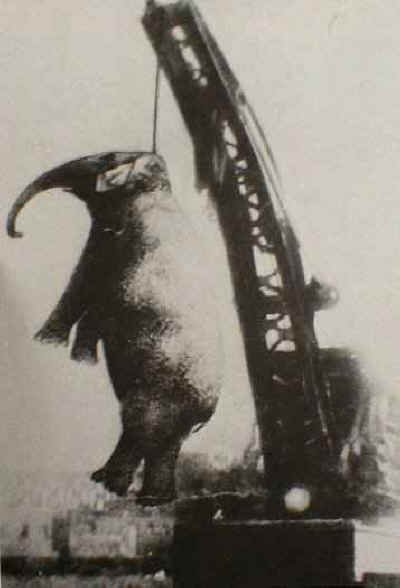
As part of my publicity push for my book, Welcome to Weirdsville, here's the sad, sad tale of Big Mary...


NEVER FORGET

Trumpeting – though no one alive can hear her; thundering down the shimmering vanishing point of the old steel rails – though no one living can feel her massing footfalls; her massive ectoplasmic essence prowls the afterlife tundra of the railway yards – maybe she tries to pull the living, so inaccessible, weeds that struggle through the creosote stained ties, between the fissures of cracked concrete; maybe she tries to bathe in the town reservoir, though the water flows through her ghostly form.

Perhaps, though the real world is denied her, it feels her presence nonetheless: Do some stare at peanuts and feel the awe and laughter of unseen audiences? Do others feel the elusive memory of hot savannas, the coughing call of hungry lions? And some unfortunate few, do they feel the bite of links around their necks, the mass of great weight parting their noble spines, blanking the world of the living, passing them onto that other sphere of the dead?

This is all speculation – all fantasy and conjecture. Truth, I do not know if she prowls the spectral side of the town, have no idea if the residents feel her presence in cotton-candy, big top dreams of circuses, or African visions of the wild. Hypothesis and imagination, yes, but I do know one thing as an absolute certainty – wherever Big Mary resides, whatever she is doing now, as her fabled nature describes, she has never forgotten what the people of Erin Tennessee did to her.

Most obviously, it isn't something the little town likes to be reminded of. In fact, I've heard, if you go poking around the railway yards, digging in slag pits and under massive pikes of old rail ties, the local citizens get rather uncomfortable, almost testy: they don't want to be known as the town that lynched the elephant.

Still, that's just what happened – and the bones of Big Mary are there somewhere.

1916 was a big year for hangings, especially in Tennessee. Strange fruit hung from a lot of trees – but none stranger than that other import from Africa.

A star of the Charlie Sparks World Famous Shows, Mary record – to be fair – was not exactly spotless. Some remember 18, others swear only two men had been killed by the African cow elephant. But whatever past raps may have been on her sheet, the cold hard fact remains that what was done to Mary was definitely unusual, and no doubt cruel.

Billed as "The Largest Living Animal On Earth" – even bigger than P. T. Barnum's Jumbo – Mary was the star of Sparks' third-rate circus. In brilliant flybills, she was touted as being able to flawlessly play 25 tunes on musical horns, and even bat .400. Of the other pachyderm's in the show, she was the stand-out favorite – a mammoth diva.


Which is why Sparks' decision can still make people scratch their heads in wonder: If Mary was so valuable ($20,000 – not a small sum in those days) when why was she given Red Eldridge as a handler – a man who had just days before been a janitor in the nearby town of St. Paul, Virginia. Even discounting the wisdom of hindsight, it does seem extremely puzzling that Sparks should give control of a known- to-be-unpredictable elephant to a man who job history could best be described as bum. A divergent thought springs to mind, a Machiavellian knot of suspicion: A failing circus, a temperamental elephant, and a 'disposable' handler – nothing like putting down a murderous elephant for gobs of publicity.

It is without a doubt that Mary had a hand – er, 'foot' – in killing Eldridge. In this case there is no one-armed man, no figure on the grassy knoll. If we have to doubt the incident that took place in the town of Kingsport, Tennessee, it is not whether Mary murdered her handler, but rather the extenuation circumstances that led to it.

The exact turn of events are hazy, and in some cases conflicting, but they all converge and agree on some very firm points. Mary was being led to a pond near where the circus was camped to bathe with the other elephants, Eldridge – as usual – was poking Mary with his elephant stick, trying to get her to toe the line, when Mary struck at her handler. 'Why' is one of those cloudy issues: Was Mary in pain from an infected tooth? Did she simply have a bad day? My favorite theory is the most heartrending – that Mary had simply moved towards a discarded watermelon rind, and that Eldridge had prodded her savagely to get her back into line.

Keeping in mind the bias of the press towards this incident – even in 1916 people really didn't want the doubt of lynching a basically innocent pachyderm – one of my favorite accounts is from the Johnson City Staff: "trunk vice-like about his body, lifted him 10 feet into the air, then dashed him with fury to the ground ... and with the full force of her beastly fury is said to have sunk her giant tusks entirely through his body. The animal then trampled the dying form of Eldridge as if seeking a murderous triumph, then with a sudden ... swing of her massive foot hurled his body into the crowd."

No defense was offered for Mary; no jury of her peers deliberated the evidence, the circumstances; no judge passed sentence on her, seeking justice. Maybe Big Mary was guilty of the crime she'd been accused of, maybe there were explanations, more evidence that needed to be heard – or perhaps it was just a slow week, and the killing of an elephant was just the thing to liven things up a bit.

Her guilt, and her punishment, was taken for granted – Mary had to die, and it was as simple as that. But how do you kill a five ton elephant? It had been done before, and would be done again – by guns and even electrical by Thomas Edison, but this was Tennessee, damnit, ... 'and in these here parts we don't take on this new-fangled way of doin' things. Down here, we need to put a feller down, we just put a rope around his neck and do the job the old-fashioned way.'

Decided in good ol' boy fashion, Mary was to die for her crime. Sparks, in a gesture of true compassion, didn't make Big Mary perform the day she was killed – but he did guarantee mourners at her execution by making a huge announcement of the event, and offering attendance for the touching fee of zilch.

So Mary was taken to Erwin, and there she was chained by one leg to a rail directly beneath Derrick Car 1400 on September 13, 1916. The crane on the Derrick car was used for lifting locomotives free of their rails – and so it was thought it could handle the task of lynching Big Mary. 5,000 people crowded the rail yards that day, perhaps munching on the treats Mary had been given when she was the star of the show – or, to give an even bigger, bitter taste of irony, maybe some of slack-jawed yokels watched and ate sweet, sweet watermelon as Mary was prepared for death.

Like all really good executions, Mary's was botched right at the start. A chain was looped around her neck, and from there to the boom of the derrick. The crowd was hushed, or maybe they just chanted "kill her" – whatever, quiet or bedlam, the end of Mary's life was at hand. The signal was given, and the crane started to work. Slowly, ponderously, the African cow elephant was lifted ... two feet off the ground, probably swinging furiously ... three – then the sound of breaking bones, snapping ligaments – the roustabouts had failed to unchain her one leg from the rail.

Her sentence had been to hang, not to be quartered. The chain, much too narrow of the job, snapped. She was smashed down onto creosote darkened ties, oil-fouled gravel. Screaming in pain – for her hip had been broken and one leg had been painfully wrenched – she thrashed around till one carnie, either stricken with conscience or seeing a chance to impress his buddies, climbed poor Mary like a minor, thrashing mountain, and attached another chain.

Then the sentence was successfully carried out: In pain, swinging her great legs, her mighty trunk, perhaps bellowing out a pitiful cry, the 10,000 pounds of Big Mary was hauled literally from this earth.

After she was dead, after the last citizen of Erwin, Tennessee had their fill of seeing her great body slowly swinging beneath the steel arm of Derrick Car 1400, Mary was finally lowered. Her tusks, it was said, were cut from her body. Her grave was then prepared – a massive pit somewhere out along the boxcars and rails, a vault for her gray remains.

A photograph of Mary was circulated sometime thereafter – and it is sadly true that while the means of her demise were never given much thought, the black and white evidence of her dangling beneath the crane was the cause of some bickering: of the hanging there could be no doubt, but was the photograph real?

Somewhere in the real yards of Erwin, Tennessee the bones of Big Mary rest – a sore point for the little town, a part of its history the residents would rather soon forget. But for Mary, wherever she is now, there is a certainty, an absolute that is definite despite all conjecture and oral history:

Big Mary will never, ever forget.

Stephen Lynch - America

Monday, December 17, 2012

The Shadow by Michael W. Kaluta

The War Game

Wiki: 
The War Game is a 1965 television documentary-style drama depicting the effects of nuclear war on Britain. Written, directed, and produced by Peter Watkinsfor the BBC's The Wednesday Playanthology series, it caused dismay within the BBC and in government and was withdrawn from television transmission on 6 August 1965 (the twentieth anniversary of the Hiroshima bombing). The Corporation said that "the effect of the film has been judged by the BBC to be too horrifying for the medium of broadcasting". However, it had some distribution in cinemas and won the Academy Award for Best Documentary Feature in 1966. But it remained unshown in full on British television until 1985. 
[MORE]

Saturday, December 15, 2012

Who?


Frank Kelly Freas

Remembering Neft Dashlari


(via estimfalos)

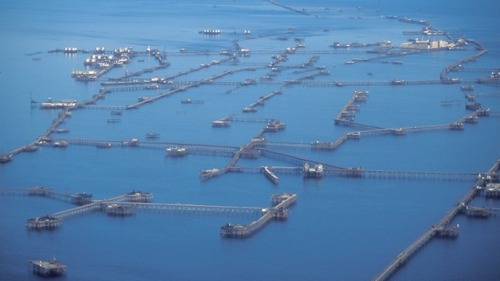
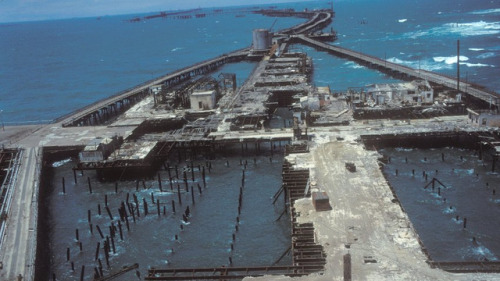
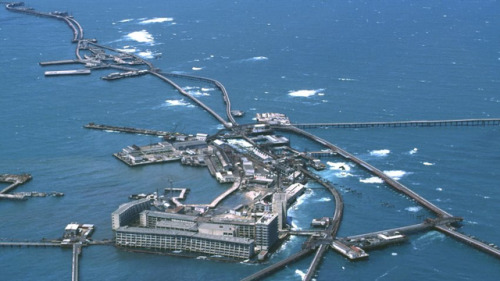
Remembering Neft Dashlari, Stalin’s utopian ocean city made from oil and steel

Shortly after the Second World War, the Soviet Union constructed a massive industrial city-complex in the Caspian Sea off the coast of Azerbaijan. Home to over 5,000 workers, it was an intricate maze of oil platforms linked by hundreds of miles of roads and featuring a park, cinema, and apartment blocks. Called Neft Dashlari, the ocean city is still in use today, but it’ll be only a matter of time before the sea completely consumes it.